




Shipping container markings play a crucial role in the global cargo transport system. They allow each container to be identified uniquely, establish its type and dimensions, and help verify compliance with the international convention concerning safe containers. Without this system, organizing the movement of goods worldwide would be considerably more difficult.
Understanding markings is not just a formality. It helps users select the correct container for the cargo being transported. In this guide, we explain which markings appear on container walls and doors, what they mean and why they matter for sea and land transport.
Basic shipping container identification markings
The most important identifier is the container number. This unique code, assigned under International Organization for Standardization (ISO) rules, comprises several components:
- Owner code – three letters identifying the company that owns the container, effectively its signature in ports worldwide.
- The letter U – a category identifier indicating a freight container; other letters can identify related equipment such as detachable equipment or trailers.
- Serial number – six digits identifying the individual unit.
- Check digit – the final character, calculated from the preceding characters to help detect data-entry errors.
The number is displayed in several places, including the container doors, side walls and roof, so that it can be identified at port terminals and from aboard a vessel. Each unit can be located in large databases, making loading, unloading and subsequent transport more efficient.
The markings also improve safety: terminal and transport staff can quickly check that the container matches the shipping documents and is in the correct location. This reduces the risk of mistakes and missing shipments throughout the global supply chain.
Looking for shipping containers for sale? See how much they can cost.
Technical markings and the CSC plate
In addition to the identification number, containers used for international transport must have a CSC plate. This metal plate, normally attached to a container door, provides official confirmation that the unit meets the requirements of the International Convention for Safe Containers (CSC).
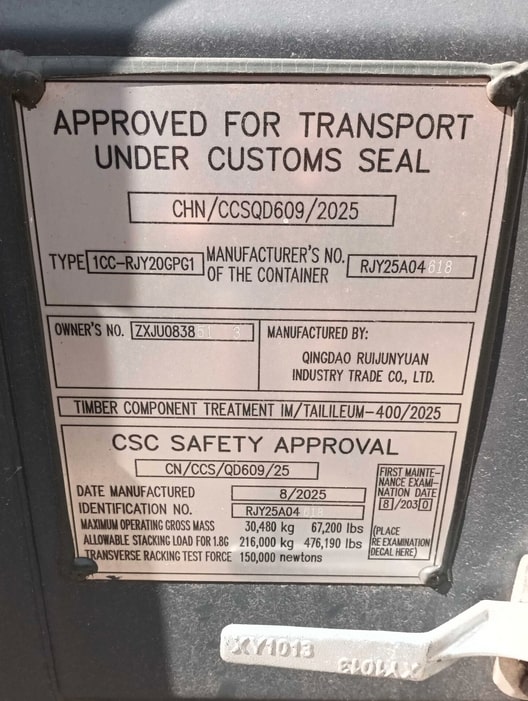
The CSC plate includes information such as:
- Maximum gross weight.
- Permitted stacking loads at the corner posts.
- Information on structural strength tests.
- Inspection dates, including the most recent and next required inspection, where applicable.
The CSC plate acts rather like a container’s official safety certificate. Containers without valid certification cannot simply be used for international shipping.
Separate operational information is also displayed on the doors, including:
- Tare weight – the weight of the empty unit.
- Payload – maximum cargo weight.
- Maximum gross weight.
- Cubic capacity, usually expressed in cubic meters.
This distinction matters. Weight and capacity information is painted directly on the container for operators to see, while the CSC plate contains the data required by the convention for safe use in international transport.
Container size and type codes
Other important shipping container markings describe the unit’s type and dimensions. Each container has codes that indicate its purpose and technical characteristics.
The size code identifies basic dimensions:
- Length, for example 20 or 40 feet.
- Height, whether standard or increased, as in High Cube models.
- Width, including wider Pallet Wide versions optimized for pallet transport where applicable.
The type code specifies its intended function, for example:
- Dry Van – general-purpose containers.
- Refrigerated container (RF/reefer) – fitted with refrigeration equipment for food and temperature-sensitive goods.
- Insulated container – helps maintain temperature without active cooling.
- Flat Rack – suitable for heavy machinery or unusually shaped loads, typically without side walls or a full roof.
- High Cube – a taller unit, identified by the relevant size code, such as an H height designation or a 5 in the four-character ISO 6346 code.
These are only the most common examples. There are also specialized models, such as tank containers for liquids and bulk containers for loose materials. Markings show whether a particular unit is suitable for bulk goods, refrigerated products or heavy machinery. ISO standardization ensures that the coding system is understood internationally.

In practice, size and type markings also help logistics operators calculate cargo volume in cubic meters and plan loading and unloading at terminals. They are essential for managing available space aboard ships and in warehouses.
Additional container markings
Besides the identification number, type code and CSC plate, shipping containers carry other technical and informational markings. These make handling easier and improve transport safety.
The upper sections of a container may carry information about maximum weight, permitted loads and cargo volume. This helps operators assess what can safely be loaded.
Specialist containers have additional markings. A refrigerated container (RF) carries technical information on the refrigeration unit’s housing, including its performance. Flat Rack units and containers with additional doors may have abbreviations describing their construction and purpose.
Markings on side walls, doors and roofs therefore serve practical as well as regulatory purposes. They provide a quick way to check key specifications and match a container to a particular load.
Why container markings matter in practice
In global transport, even a small mistake can lead to delays and losses. Shipping container markings are therefore vital to port operators, freight forwarders and logistics companies.
Clear identification allows accurate planning of loading, unloading and storage at terminals. Codes and technical data also help optimize space aboard ships, affecting efficiency and transport costs.
Safety is equally important. Information about tare weight, maximum gross weight and cargo capacity helps prevent overloading or unsuitable use. This is especially important for sensitive cargo such as food, chemicals and heavy machinery.
The markings also indicate the correct container type for the goods being shipped. A Dry Van is suitable for general cargo, while a refrigerated container is required for products needing temperature control. Clear markings reduce errors and improve reliability.
Shipping container types and their markings
The marking system makes it easy to distinguish different shipping container types and their intended uses. Common varieties include:
- Dry Van – the most common general-purpose containers in sea transport, identified by standard size and type codes.
- High Cube – increased height provides room for greater cargo volume; the size code distinguishes them from standard models.
- Flat Rack – typically lacks side walls and a full roof, accommodating heavy machinery and oversized loads.
- Refrigerated container (RF) – has a refrigeration unit to maintain temperatures for food and sensitive products; manufacturer and performance details appear on the equipment housing.
- Insulated containers – lack active refrigeration but have insulated walls, making them suitable for certain temperature-sensitive shipments over shorter periods.
- Open Top – have an open roof, normally covered with a tarpaulin rather than a rigid roof, for oversized or top-loaded cargo.
- Tank (ISO Tank) – tank containers for liquids, gases and chemicals; technical markings specify properties such as maximum working pressure and permitted contents.
- Bulk – containers for bulk commodities such as grain, animal feed and granules, typically with top filling openings and bottom discharge hatches.
- Ventilated – extra air vents make them useful for products such as coffee and cocoa that need air circulation.
- Double Door / Side Door – have extra doors on the sides or at both ends to simplify cargo handling.
Standard markings let port and terminal operators immediately identify the container type, dimensions, permitted loads and products that can safely be carried.
Summary
Shipping container markings are fundamental to the global movement of goods. They identify the container number, type, dimensions, permitted payload and compliance with the international convention on safe containers. Information shown on doors, side walls and the CSC plate supports efficient and safe loading, unloading and storage.
A uniform system based on ISO standards and container industry procedures makes these markings understandable in ports around the world. They support both efficient logistics and safe cargo handling.
For transport and container trading businesses, interpreting codes, abbreviations and technical specifications is part of everyday work. Correct interpretation helps select a container suited to the cargo, optimize operations and avoid mistakes. Every marking has a specific meaning and a practical role in international trade.