



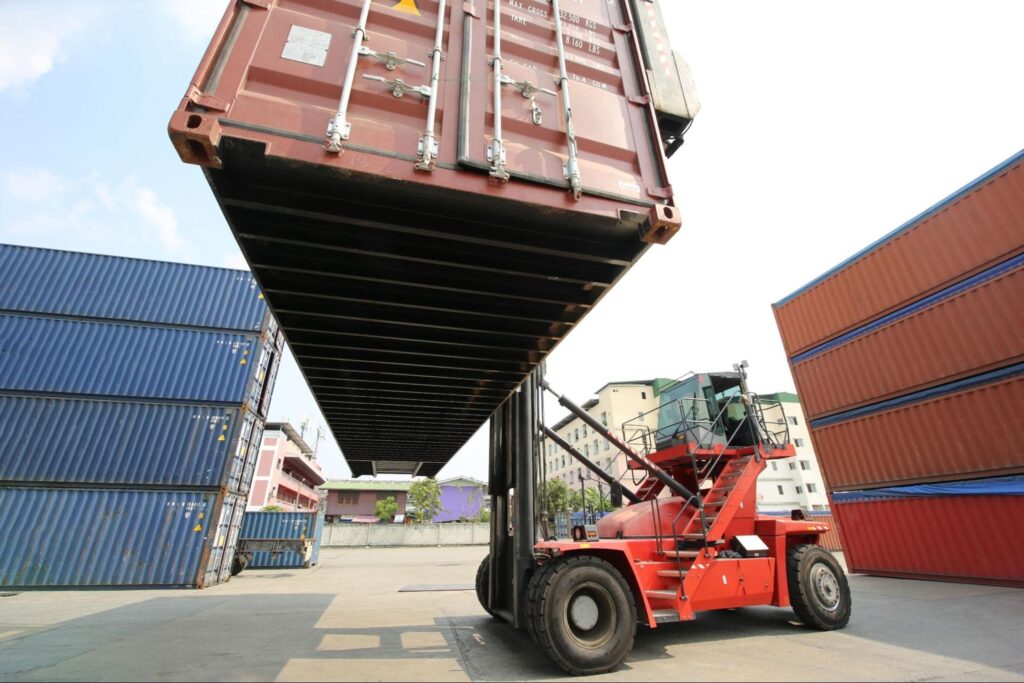
Containers—whether shipping, office or welfare units—are increasingly appearing on private plots, construction sites and in urban spaces. They are used as storage containers, technical facilities, service outlets and even year-round homes. Their quick installation and mobile nature appeal to investors looking for alternatives to conventional buildings. Many people nevertheless wonder whether it is legal to place a container without notifying the authorities. Is a building permit necessary? Which regulations govern a container’s legal status, and what happens if it is installed without the required formalities?
This article explains when a container is treated as a structure under building law, when a permit is required and when notification is sufficient. We discuss Poland’s Construction Law, local regulations and common mistakes made by investors.
What is a container under construction law?
Although containers are mainly associated with maritime transport, under Polish construction law a container may be considered a construction object if specific criteria are met. Article 3(1) of the Construction Law defines construction objects to include buildings, structures and small architectural objects, together with their parts. In the context of containers, Article 3(5), concerning a temporary construction object, is particularly relevant: an object intended for temporary use that is not permanently attached to the ground.
In practice, shipping containers may be classified as:
- Temporary structures, installed for the duration of construction work, for example site cabins or welfare containers.
- Container buildings, where they are installed permanently, connected to utilities and intended for long-term use.
The classification depends not simply on a container’s dimensions or appearance but on how it is installed and what it is used for. Even a movable container that is not permanently attached to the land may require a building notification or permit, particularly if used on an ongoing or commercial basis.
Containers with a usable floor area of up to 35 m² may serve various purposes, including temporary accommodation, without a permit if they meet local building regulations and planning requirements. However, the applicable formalities should always be checked: exemption from a building permit does not necessarily mean exemption from notification.
The following sections explain when a permit is necessary, when notification is sufficient and when a container may be installed without either, provided the law allows it.
When does placing a container require notification, and when a permit?
The general principle under the Construction Law of 7 July 1994 is that construction objects, including temporary ones, may require a notification or building permit depending on their purpose, intended period of use and method of installation.
Notifying the authorities about a container
According to Article 29(1)(12) and Article 30(1)(2) of the Construction Law as cited in this article, installing a temporary construction object for less than 180 days requires notification if it is not associated with permanent, ongoing use. Thus, notification may suffice for a container placed for the duration of construction work, such as a technical facility.
The article states that the relevant documents should be submitted to the local building-supervision authority and include:
- The planned start and end dates of the container’s use.
- A sketch or description of its location.
- Confirmation that it complies with the local spatial development plan.
If the authority raises no objection within 21 days—the so-called tacit approval period—the container can be installed. Containers used temporarily to store building materials or to provide welfare facilities for construction workers generally do not require notification or a permit, according to the article, provided they are not permanent structures and only serve construction work.
Building permits for containers
A building permit is required, according to the article, when a container:
- Is intended to be used for more than 180 days.
- Is permanently attached to the ground, for example on foundations or with utility connections.
- Serves a permanent function, such as an office, service outlet or dwelling.
Obtaining a permit involves a more extensive procedure, including a building design, an environmental decision if required, and compliance with the local spatial development plan or a decision on development conditions. Even a container not permanently fixed to the ground may be considered by building-supervision authorities to require a permit if used over a long period.
Considering a home built from shipping containers? Read our guide.

The importance of local spatial development plans
Whether a container can be placed without notification depends on more than its mobility or function. Local spatial development plans (MPZP) regulate what can be built and where, including temporary construction objects. A container installed on private land away from public roads and without adverse effects on the surroundings may be easier to accommodate in planning terms, provided its function fits the land designation. This does not automatically remove the notification obligation: the requirements depend on how long and in what way the container will be used and whether it is temporary or permanent.
What does the MPZP contain, and why is it important?
The local spatial development plan specifies, among other matters:
- The intended use of land, for example residential, commercial or industrial development.
- Permitted forms of development and land use.
- Restrictions arising from environmental protection, protection of cultural landscapes or fire-safety regulations.
If the plan permits only single-family housing in a particular area, an office or storage container may be inconsistent with it, even if the container is temporary and not permanently fixed to the ground. If a container stands in a place prohibited by the plan, retrospective approval may be impossible. Without an MPZP, a decision on development conditions may be needed, for example to legally erect an outbuilding made from a container.
What if there is no MPZP?
Where no local spatial development plan is in force, it may be necessary to obtain a decision on development conditions. This additional administrative procedure lengthens the project but may be required for lawful installation. Ignoring the rules can lead to a demolition order, even if the container is on privately owned land. Consult the municipality and check the applicable planning regulations before proceeding.
Placing a container without notification: legal consequences
Installing a container without completing the required formalities risks being treated as unauthorized construction. Such installation can have serious administrative, financial and potentially criminal consequences. Whether the container stands on private land, a construction site or public land, the owner may face enforcement action if a required notification or permit was not obtained.
What can happen if a container is placed without notification?
If a building-supervision body, such as the district building-supervision inspector, finds that a container was installed illegally, it may:
- Issue a demolition order.
- Impose a fine, as described in the article with reference to Articles 48 and 49b of the Construction Law.
- Initiate retrospective legalization proceedings, which can be expensive and may not succeed.
To legalize an unlawfully installed container, the investor must demonstrate compliance with the law and local spatial development plan and provide the required documentation, much as if applying for permission from the outset.
Common mistakes made by investors
- Treating a container as garden furniture exempt from building regulations.
- Failing to check the MPZP and placing a container in a prohibited location.
- Exceeding the 180-day period for a temporary structure without notifying the authorities of a new location.
Ignoring formalities, even in good faith, can result in prolonged administrative disputes and the need to remove the container. Complying with the applicable rules helps avoid legal problems.
Can you place a container on your own plot without formalities?
Some landowners assume they can place any container on their property without approval. However, Polish construction law does not provide a blanket exemption simply because the land is privately owned. Where a container meets the criteria for a construction object, notification or a permit may still be required.
Private ownership is not an exemption
Even if a container serves as a private storage unit or holiday cabin on your own land, it:
- Must comply with the local spatial development plan.
- Must meet applicable distance requirements from plot boundaries, commonly stated here as at least 3 m for structures without windows and 4 m for those with windows.
- Should meet safety, fire-protection and landscape requirements.
Example: a container at the plot boundary
Placing a container directly on the boundary may breach regulations unless specific technical conditions are met or the MPZP permits it. Otherwise, neighbors may contact the building-supervision authority, potentially resulting in an order to move or remove the container.
Ownership of the land alone does not exempt anyone from construction regulations. Check whether the container complies with applicable requirements and whether notification or a permit is needed.

Practical ways to avoid legal problems
Installing a container may seem straightforward, but some basic precautions help avoid disputes with authorities or neighbors.
Consult the authorities before starting
Before buying or installing a container:
- Check the local spatial development plan, available from the municipality or online.
- Ask the local building-supervision inspector whether notification or a permit is required.
- If no MPZP applies, apply for a decision on development conditions where necessary.
Early consultation helps avoid unnecessary paperwork and administrative decisions that could block a project.
Prepare the required documents
A notification usually involves:
- A notification form.
- A map marking the proposed container location.
- A technical description or sketch.
- The intended period of use.
If a building permit is necessary, a building design prepared by an appropriately qualified professional will also be required.
Choose a container that complies with the rules
Consider:
- The type of container, such as storage, office or sanitary.
- The intended period of use: less or more than 180 days.
- Its function, including whether it will be used privately or for business.
- Its location relative to plot boundaries and existing buildings.
Accounting for these factors can help prevent difficulties during inspections and allegations of unauthorized construction.
Property tax and containers
In addition to administrative requirements, installing a container can have tax consequences. Depending on their purpose and legal classification, containers may be subject to property tax.
When is tax payable?
Referring to Article 2(1) of the Polish Local Taxes and Fees Act, the article states that property tax includes certain buildings and structures attached to the ground. If a container stands on foundations, is connected to utilities and has a usable function such as an office, shop or food outlet, it may be classified as a structure and become taxable, with tax generally calculated as a percentage of its value.
In practice, classification depends on the competent local authority’s interpretation or a court ruling. The article notes examples of containers treated as equipment rather than taxable structures, and others taxed as buildings.
A note on business containers
If a container is used for business, a tax inspection may classify it as a fixed asset or property for tax purposes, particularly if it appears in the company’s asset register. The article advises ensuring that the container’s documentation and actual use reflect whether it is permanently attached to the land. Tax classification must nevertheless follow the applicable law rather than simply the owner’s preferred description.
Summary
Placing a container without notification may look appealing, but it can create serious legal complications. The key issues are whether the container is temporary, how long it will be used and whether it is permanently attached to the ground. Before installing it, check local regulations, assess the risks, prepare the required documents and follow the applicable legal procedures. This is the simplest way to avoid expensive mistakes.